

Define Fiqh: Complete Guide to Islamic Jurisprudence and Its Essential Role in Modern Muslim Life
Understanding Islamic jurisprudence has never been more crucial for Muslims navigating the complexities of modern life. Whether you’re seeking to deepen your spiritual practices or gain comprehensive religious guidance, learning to define fiqh properly forms the foundation of Islamic studies. This comprehensive guide illuminates the rich tapestry of Islamic legal thought, exploring fundamental principles that have guided Muslim communities for over fourteen centuries.
At Al Nijah Quran Academy, we understand that mastering Islamic jurisprudence requires authentic online Quran learning combined with expert guidance from certified Quran teachers. Our interactive online Quran classes provide the perfect foundation for understanding how Quranic teachings translate into practical legal frameworks.
What is Fiqh? The Essential Definition
Fiqh (Arabic: فقه), derived from the root meaning “deep understanding” or “full comprehension,” refers to Islamic jurisprudence—the human interpretation and application of Islamic law (Sharia) based on the Quran and the Sunnah. This definition encompasses both the methodology of deriving legal rulings and the practical guidance Muslims need for their daily lives.
The Quran emphasizes the importance of seeking this deep understanding:
“And it is not for the believers to go forth [to battle] all at once. For there should separate from every division of them a group [remaining] to obtain understanding in the religion (li-yatafaqqahu fi’d-din) and warn their people when they return to them that they might be cautious.” (Quran 9:122)
This verse highlights tafaqquh (deep comprehension), which forms the essence of fiqh and distinguishes it from mere surface-level knowledge.
Fiqh vs. Sharia: Understanding the Distinction
While often confused, fiqh and Sharia serve different roles in Islamic legal thought:
- Sharia represents divine guidance found directly in the Quran and authentic Sunnah
- Fiqh constitutes human interpretation and application of this divine guidance to specific situations
This distinction becomes crucial when addressing contemporary issues that require scholarly interpretation within the framework of eternal Islamic principles.
Historical Development: From Revelation to Codification
Islamic jurisprudence evolved systematically from the time of Prophet Muhammad (peace be upon him) through the efforts of early companions and subsequent generations of scholars. The development process involved:
- Prophetic Period: Direct guidance through divine revelation and prophetic practice
- Companion Era: Application of Quranic and prophetic principles to new situations
- Systematic Codification: Formation of distinct methodological schools
The Prophet Muhammad (peace be upon him) emphasized the importance of seeking knowledge:
“Whoever takes a path upon which to obtain knowledge, Allah makes the path to Paradise easy for him.” (Sahih Muslim)
This prophetic guidance continues to inspire institutions like Islamic Society of North America (ISNA) in promoting authentic Islamic education globally.
The Four Schools of Islamic Jurisprudence
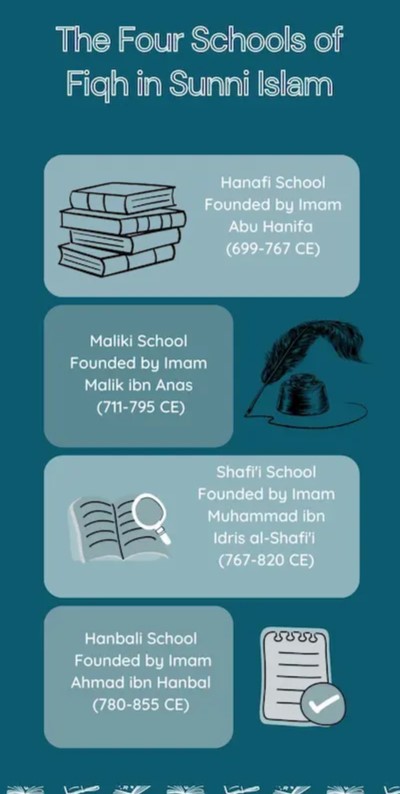
Sunni Islam recognizes four major schools of Islamic jurisprudence, each contributing unique methodological approaches while maintaining unity on fundamental principles:
1. Hanafi School
Founder: Imam Abu Hanifa (699-767 CE)
- Methodology: Emphasizes rational reasoning (ra’y) and juristic preference (istihsan)
- Geographic Influence: Predominant in Turkey, Central Asia, Indian subcontinent, and parts of the Arab world
- Key Characteristic: Flexible approach accommodating diverse cultural contexts
2. Maliki School
Founder: Imam Malik ibn Anas (711-795 CE)
- Methodology: Relies heavily on practices of Medina (‘amal ahl al-Medina) as authentic Sunnah
- Geographic Influence: Dominant in North and West Africa
- Key Characteristic: Emphasis on public interest (maslaha) and local customs
3. Shafi’i School
Founder: Imam Muhammad ibn Idris al-Shafi’i (767-820 CE)
- Methodology: Systematic approach prioritizing Quran, Sunnah, consensus (ijma), and analogy (qiyas)
- Geographic Influence: Prevalent in Southeast Asia, parts of Africa, and the Middle East
- Key Characteristic: Balanced methodology between textual sources and rational reasoning
4. Hanbali School
Founder: Imam Ahmad ibn Hanbal (780-855 CE)
- Methodology: Strict adherence to Quranic and prophetic texts
- Geographic Influence: Primarily in Saudi Arabia and surrounding regions
- Key Characteristic: Conservative approach emphasizing textual evidence
The Quran acknowledges the wisdom in scholarly differences:
“And if your Lord had willed, He could have made mankind one community; but they will not cease to differ.” (Quran 11:118)
Organizations like Fiqh Academy of India continue this tradition by addressing contemporary jurisprudential challenges.
The Five Objectives of Islamic Law (Maqasid al-Shariah)
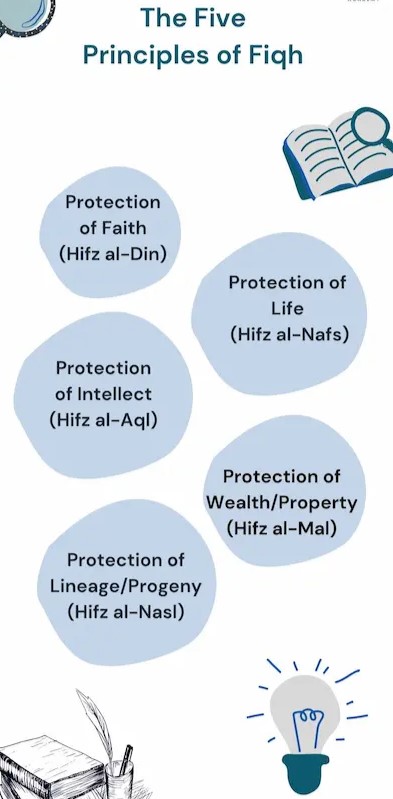
Islamic jurisprudence operates within a comprehensive framework designed to protect and promote human welfare through five fundamental objectives:
1. Protection of Faith (Hifz al-Din)
Preserving religious belief, practice, and the right to worship according to Islamic principles.
2. Protection of Life (Hifz al-Nafs)
Safeguarding human life through laws governing self-defense, medical ethics, and criminal justice.
3. Protection of Intellect (Hifz al-Aql)
Promoting education, rational thinking, and prohibiting substances that impair mental faculties.
4. Protection of Lineage (Hifz al-Nasl)
Maintaining family structure, marriage laws, and regulations ensuring legitimate descent.
5. Protection of Wealth (Hifz al-Mal)
Establishing property rights, commercial law, and prohibition of theft and fraud.
These principles reflect the Quranic declaration:
“And We have not sent you, [O Muhammad], except as a mercy to the worlds.” (Quran 21:107)
Contemporary scholars at institutions like International Islamic Fiqh Academy apply these principles to modern challenges including bioethics, environmental protection, and financial regulations.
The Five Fundamental Legal Maxims (Al-Qawa’id Al-Fiqhiyyah)
Islamic jurisprudence relies on five major legal maxims that guide the derivation of rulings:
1. Al-Umuru Bi Maqasidiha (الأمور بمقاصدها)
“Actions are judged by their intentions”
Based on the prophetic hadith:
“Actions are but by intentions, and every man shall have only that which he intended.” (Sahih al-Bukhari)
This maxim emphasizes the crucial role of intention in determining the legal and moral value of actions.
2. Al-Yaqinu La Yazulu Bi Ash-Shakk (اليقين لا يزول بالشك)
“Certainty is not overruled by doubt”
This principle maintains established legal states until definitive evidence proves otherwise, providing stability in legal decisions.
3. Al-Mashaqqatu Tajlibu At-Taysir (المشقة تجلب التيسير)
“Hardship begets facility”
Reflecting the Quranic principle: “Allah intends for you ease and does not intend for you hardship” (Quran 2:185), this maxim allows for legal concessions during difficult circumstances.
4. Ad-Dararu Yuzal (الضرر يزال)
“Harm must be eliminated”
This principle prioritizes preventing or removing harm, forming the basis for many protective regulations in Islamic law.
5. Al-‘Adatu Muhakkamah (العادة محكمة)
“Custom is a basis of judgment”
Recognizing that local customs and cultural practices can influence legal rulings, provided they don’t contradict Islamic principles.
Categories and Classifications in Fiqh
Four Main Subject Areas
Islamic jurisprudence traditionally divides into four comprehensive categories:
1. Ibadat (Acts of Worship)
- Salah (Prayer): Daily prayers, congregational worship, special prayers
- Sawm (Fasting): Ramadan fasting, voluntary fasts, exemptions
- Zakat (Almsgiving): Wealth purification, distribution to deserving recipients
- Hajj (Pilgrimage): Sacred journey requirements and rituals
2. Mu’amalat (Transactions and Contracts)
- Commercial law, banking regulations, business ethics
- Contract formation, property rights, employment law
- Contemporary issues: Islamic finance, cryptocurrency, e-commerce
3. Munakahat (Family Law)
- Marriage contracts, matrimonial rights and responsibilities
- Divorce procedures, child custody, inheritance distribution
- Gender roles and family dynamics within Islamic framework
4. Jinayat (Criminal Law)
- Crime classification, punishment guidelines, rehabilitation
- Justice system operation, evidence requirements
- Restorative justice and community protection
Five Legal Classifications
Every action in Islamic law falls into one of five categories:
- Fard (Obligatory): Required actions whose omission constitutes sin
- Mustahabb (Recommended): Praiseworthy actions bringing spiritual reward
- Mubah (Permissible): Neutral actions with no reward or punishment
- Makruh (Discouraged): Actions better avoided but not sinful
- Haram (Prohibited): Forbidden actions constituting sin
Fiqh and Akhlaq: Law and Ethics in Harmony
Understanding how to define fiqh requires recognizing its relationship with Akhlaq (Islamic ethics and moral character). While fiqh provides legal framework, akhlaq encompasses the spiritual and ethical dimensions of Islamic life.
The Prophet Muhammad (peace be upon him) said:
“I have been sent to perfect good character.” (Reported by Ahmad)
This integration of law and ethics ensures that Islamic jurisprudence serves not merely as legal compliance but as a pathway to spiritual excellence and moral character development.
Modern Islamic education institutions recognize this connection. At Al Nijah Quran Academy, our comprehensive approach to Arabic learning and Quran recitation integrates both legal understanding and ethical development, helping students develop well-rounded Islamic personalities.
Contemporary Applications and Modern Challenges
Islamic jurisprudence continues evolving to address contemporary challenges while maintaining fidelity to foundational principles:
Technology and Digital Age
- Online transactions: E-commerce regulations, digital contracts
- Social media: Privacy rights, information sharing ethics
- Artificial intelligence: Automation in Islamic finance, decision-making systems
Medical and Bioethics
- Organ transplantation: Donor consent, life preservation priorities
- Genetic engineering: Therapeutic applications versus enhancement
- End-of-life care: Pain management, life support decisions
Environmental Stewardship
- Climate change: Islamic responsibilities toward creation
- Resource conservation: Sustainable development principles
- Animal welfare: Rights of animals in Islamic perspective
Financial Systems
- Islamic banking: Sharia-compliant financial products
- Cryptocurrency: Digital currency compatibility with Islamic principles
- Global economy: Ethical investment guidelines
Institutions like Islamic Society of North America regularly convene scholars to address these emerging issues through collective reasoning and consensus-building.
Methodology of Islamic Jurisprudence (Usul al-Fiqh)
Understanding fiqh requires grasping the systematic methodology scholars use to derive rulings:
Primary Sources
- Quran: Divine revelation providing fundamental guidance
- Sunnah: Prophetic tradition exemplifying Quranic implementation
Secondary Sources
- Ijma (Consensus): Scholarly agreement on specific issues
- Qiyas (Analogy): Applying established rulings to similar new situations
Additional Methodological Tools
- Istihsan: Juristic preference for equity over strict analogy
- Maslaha: Public interest considerations
- Urf: Acceptable local customs and practices
- Sadd al-Dhara’i: Blocking means leading to prohibited ends
Learning Fiqh: A Practical Approach
For students beginning their journey to understand and define fiqh, systematic study proves essential:
Prerequisites
- Arabic language proficiency: Understanding original texts
- Quranic studies: Familiarity with divine guidance
- Hadith knowledge: Prophetic tradition comprehension
- Islamic history: Contextual understanding of legal development
Progressive Learning Stages
- Foundation: Basic definitions, categories, and principles
- Intermediate: Detailed study of specific areas (worship, transactions)
- Advanced: Comparative jurisprudence, contemporary applications
- Specialization: Focus on particular schools or subject areas
Al Nijah Quran Academy offers structured programs supporting this progression. Our certified Quran teachers provide personalized guidance helping students master both Quran recitation and comprehension necessary for advanced Islamic studies. Through our interactive online Quran classes, students worldwide access authentic Islamic education that forms the foundation for deeper jurisprudential understanding.
Common Misconceptions About Fiqh
Misconception 1: “Fiqh and Sharia are identical”
Reality: Sharia represents divine guidance, while fiqh constitutes human interpretation of that guidance.
Misconception 2: “Islamic law is rigid and unchanging”
Reality: Fiqh methodologies allow for adaptation to new circumstances while maintaining core principles.
Misconception 3: “Only trained scholars can understand fiqh”
Reality: While scholarly expertise remains crucial for complex issues, basic fiqh principles remain accessible to all Muslims.
Misconception 4: “Cultural practices equal Islamic law”
Reality: Distinguishing between religious requirements and cultural traditions requires careful study.
The Role of Qualified Scholarship
Proper understanding of Islamic jurisprudence requires qualified scholarly guidance. The Quran emphasizes:
“So ask the people of the message if you do not know.” (Quran 16:43)
Contemporary institutions maintaining this scholarly tradition include:
- Islamic Society of North America (ISNA) – Promoting authentic Islamic education in North America
- International Islamic Fiqh Academy – Addressing modern jurisprudential challenges
- Fiqh Academy of India – Regional jurisprudential guidance
These organizations demonstrate how traditional Islamic scholarship adapts to serve contemporary Muslim communities while maintaining authenticity and scholarly rigor.
Conclusion: The Enduring Relevance of Islamic Jurisprudence
Learning to define fiqh opens doorways to understanding Islam’s comprehensive guidance system. Islamic jurisprudence provides not merely legal framework but a complete approach to living that integrates spiritual, ethical, and practical dimensions of human existence.
The five schools of thought, fundamental principles, and methodological approaches developed over centuries continue serving Muslim communities worldwide. From personal worship to complex contemporary challenges, fiqh offers guidance rooted in divine revelation yet flexible enough to address evolving circumstances.
As the Prophet Muhammad (peace be upon him) reminded us:
“Whoever Allah wishes good for, He gives him understanding of the religion.” (Sahih al-Bukhari)
At Al Nijah Quran Academy, we’re committed to facilitating this divine blessing through authentic online Quran learning. Our comprehensive programs combine traditional scholarship with modern convenience, helping students develop the Arabic learning skills and Quran recitation proficiency necessary for deeper Islamic understanding.
Whether you’re beginning your journey to understand Islamic jurisprudence or seeking to deepen existing knowledge, remember that this pursuit of understanding represents both intellectual achievement and spiritual development. Join our global community of learners today, where traditional Islamic knowledge meets modern educational convenience.
Start your free trial and experience personalized Islamic education that not only teaches you to define fiqh but helps you live its principles, strengthening your connection with Allah and enriching your spiritual journey.